Shop by need
Shoes for swollen feet
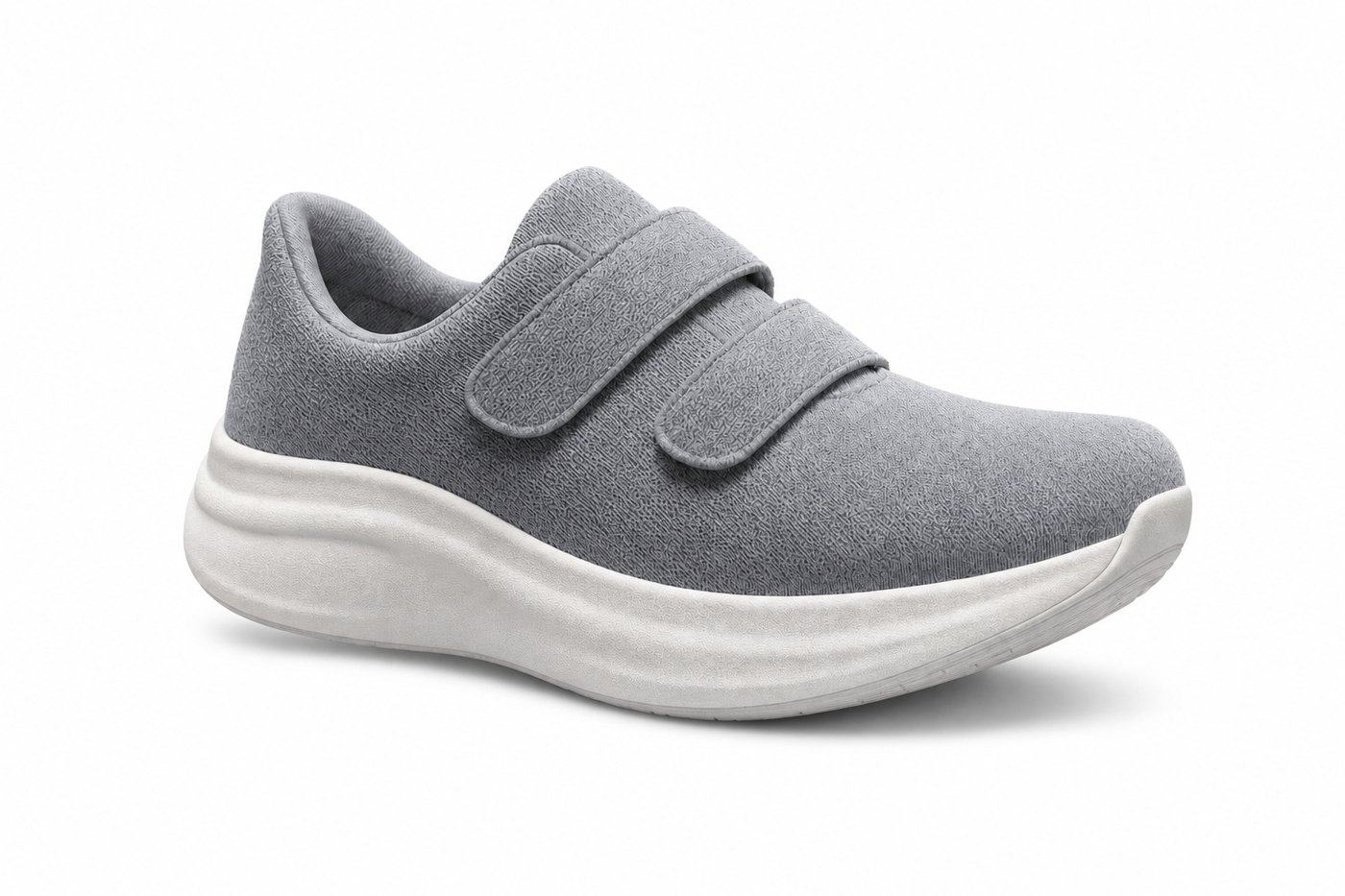
Feet that fit at breakfast and do not fit by teatime need a shoe that can change shape with them. The Everyday opens completely flat, adjusts at two points and comes in a 6E fitting — the widest sold in UK retail.
Why ordinary shoes fail on a swollen foot
Swelling is not simply a wider foot. It is a foot with more volume — more depth over the instep, more girth at the ball, and often more circumference at the ankle. A shoe sized up in length gives you none of that. It gives you a longer shoe that still presses in exactly the same places, and now slips at the heel as well.
The three failures people describe to us, in order: the shoe will not go on past mid-afternoon; the top of the foot is marked by the fastening; the little toe or the fifth metatarsal joint burns after twenty minutes. All three are volume problems, not length problems.
What actually helps
Adjustability at two points. One strap sets the shoe. Two straps let you loosen the forefoot without losing the instep, which matters because feet rarely swell evenly.
A shoe that opens flat. If the strap releases all the way and the collar folds back, the foot goes in from above rather than being pushed forwards into the shoe. That single detail is the difference between dressing yourself and asking for help.
Genuine extra depth. Not just width. Volume over the instep is what runs out first, and it is the measurement almost no high-street shoe publishes.
Seam-free inside. Swollen skin is stretched skin, and stretched skin marks easily. Nothing should be stitched where the foot presses.
Which fitting to start with
If your feet swell noticeably during the day, size for the worst part of the day, not the best.
| Fitting | Roughly equals | Choose it if |
|---|---|---|
| EE (Wide) | About one fitting above a standard high-street trainer | Standard trainers feel tight across the ball of the foot but you can wear them |
| EEEE (Extra Wide) | Two to three fittings above standard | Bunions, a spreading forefoot, or you wear a custom orthotic |
| 6E (Ultra Wide) | The widest fitting sold in UK retail | Oedema, lymphoedema, bandaging, or feet that change size through the day |
Still unsure? The width finder takes three questions, or you can measure your feet at home in about four minutes.
Measuring a foot that changes size
Measure at the end of the day, sitting, with your foot flat on the floor and your weight through it. Do it twice, a day apart. If the two girth measurements differ by more than about 8 mm, buy for the larger figure and use the straps to take up the slack in the morning — a shoe you can tighten is far more useful than one you can only loosen.
If one foot is consistently larger, fit the larger foot. We will supply two different widths or sizes and refund the spare pair; email the order number and we will sort it.
When swelling needs a clinician, not a shoe
New swelling in one leg, swelling with pain, redness or heat, swelling with breathlessness, or skin that is weeping or breaking down all need medical assessment rather than a new pair of shoes. Sudden swelling in one calf in particular should be seen the same day. Persistent swelling in both feet is worth a GP appointment — the cause changes what helps.
If you are already under a lymphoedema or tissue viability service, ask what depth your bandaging or compression garment needs, and read the oedema and lymphoedema footwear guide before ordering.
Common questions
What is the widest fitting you make?
Will these fit over bandaging or a compression wrap?
My feet swell more in hot weather. Should I size up?
Are these suitable for oedema and lymphoedema?
Can I wear my own insoles in them?
Where to go next
Oedema & lymphoedema footwear
Depth, compression garments and what a trainer can and cannot do.
Find my width
Three questions and we name the fitting to start with.
What the NHS provides
Who qualifies for footwear on the NHS, and what to do while you wait.
Extra wide fit trainers
EEEE and 6E, every size, one style.
One trainer, three fittings, sixty days to get it right
The Everyday is £89 in EE, EEEE and 6E on every size from UK 3 to 13. Free UK delivery, and if the width is wrong we post the replacement before the first pair comes back.