Fit & sizing
Measure your feet at home
Most people are wearing the size they were measured for as a teenager. Feet get longer, wider and flatter with age, pregnancy, weight change and time on your feet. Four minutes now saves a return later.
What you need
A sheet of A4 paper, a pen held upright, a ruler, a tape measure, and a wall. Do it at the end of the day — feet are at their largest then, and a shoe fitted to a morning foot will hurt by four o'clock. Wear the socks you will wear with the shoes.
Step one: length
Put the paper on a hard floor with one short edge against the wall. Stand on it with your heel touching the wall and your weight through the foot — not sitting down, and not with the foot lifted. Have someone mark the paper at the tip of your longest toe, keeping the pen vertical. Measure from the wall edge to the mark in millimetres.
Repeat for the other foot. They will differ, often by several millimetres. Always use the larger figure. Add 10 mm of toe room to get the internal length your shoe needs.
Step two: girth (the one that decides fit)
Standing, with weight through the foot, run the tape measure around the widest part — over the joint at the base of the big toe and around past the joint at the base of the little toe. Snug, not tight; the tape should sit on the skin without compressing it. Record both feet in millimetres.
Girth is what decides whether you need EE, EEEE or 6E. Length only decides the number.
Step three: instep, if your feet swell
Measure the circumference diagonally over the highest point of the instep, from the base of the heel up over the top of the foot. This is the measurement that decides whether a shoe will actually fasten on a swollen foot, and it is the one nobody takes. If it varies by more than 8 mm between morning and evening, fit for the evening figure and use the straps to take up the difference.
Reading the numbers
| Length (mm, larger foot) | UK size | EU |
|---|---|---|
| 219–227 | UK 3 | 36 |
| 226–234 | UK 4 | 37 |
| 234–242 | UK 5 | 38 |
| 241–249 | UK 6 | 39 |
| 249–257 | UK 7 | 41 |
| 256–264 | UK 8 | 42 |
| 264–272 | UK 9 | 43 |
| 271–279 | UK 10 | 44 |
| 279–287 | UK 11 | 45 |
| 286–294 | UK 12 | 46 |
| 294–302 | UK 13 | 48 |
Length here is the foot itself; the shoe adds toe room on top. If you fall between two sizes, take the larger one and use the straps to fine-tune.
Five mistakes that cost people a size
Measuring in the morning. Feet are smallest then and the shoe will be tight by evening.
Measuring sitting down. A loaded foot is meaningfully longer and wider than an unloaded one.
Measuring only one foot. Nearly everyone has a larger side.
Holding the pen at an angle. It adds up to 5 mm. Keep it vertical against the toe.
Assuming the big toe is longest. Very often it is the second toe, and that is the one that hits the end of the shoe.
Common questions
What time of day should I measure my feet?
Should I measure sitting or standing?
My feet are different sizes. Which one do I use?
How much toe room should I leave?
How often should I re-measure?
Where to go next
Free download
Printable A4 foot gauge
Print at 100 per cent scale, check the test line with a ruler, put it on a hard floor with the heel edge against a wall, and stand on it. Length and girth scale on one sheet.
Download the gauge (SVG, prints to A4)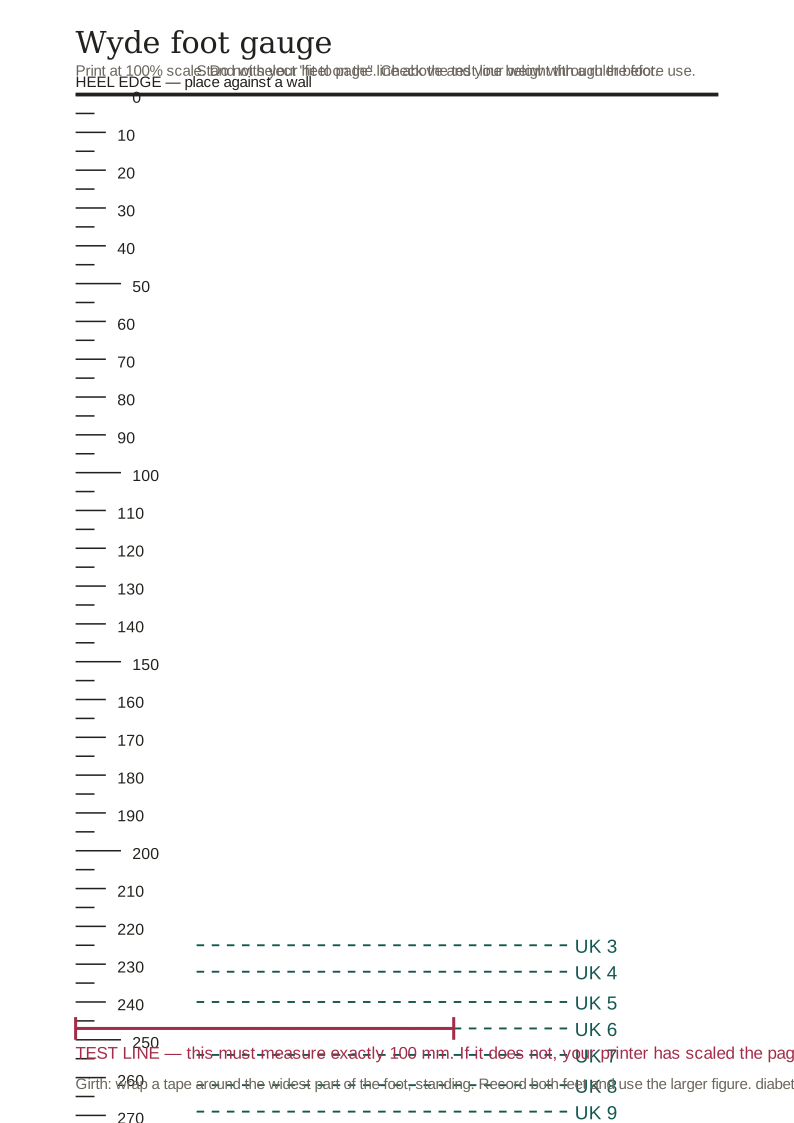
Do not select "fit to page" or "shrink to fit" — it will print the wrong size and the measurement will be useless.